
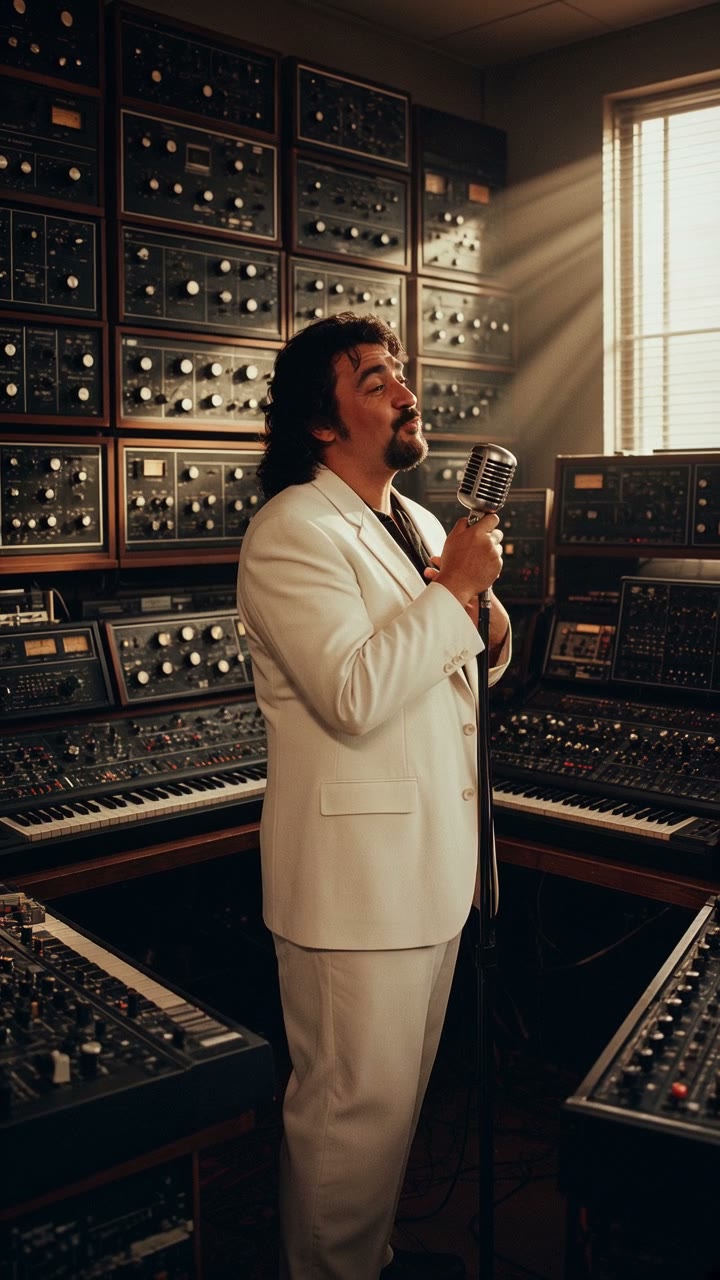
In 1982, the world of cinema changed forever, not just because of the visual genius of Ridley Scott, but because of a haunting, atmospheric masterpiece that defined the sound of the future. When we think of the Blade Runner soundtrack, we are transported back to a time of neon-drenched rain and high-tech decay. Yet, the man behind this sonic architecture, Vangelis, did not approach this project like a typical composer. He did not sit at a grand piano with sheet music or spend weeks meticulously drafting melodies. Instead, he stepped into his studio with a singular vision, relying entirely on real-time improvisation to craft a landscape of sound that still chills the bones of listeners today.
At the peak of the synthesizer revolution, when digital innovation began to collide with human emotion, Vangelis was a pioneer. He treated his synthesizers not as calculators of sound, but as living, breathing extensions of his own psyche. The creation of the Blade Runner score remains one of the most fascinating tales in the history of film. Without writing a single traditional note, Vangelis manipulated his equipment to produce those iconic, mournful textures that captured the lonely essence of Rick Deckard’s world. It was a raw, unfiltered performance—a stream of consciousness captured directly onto magnetic tape.
This was an era defined by the rise of the Walkman and the burgeoning curiosity for synthetic, experimental textures. While the rest of the world was dancing to the polished beats of the Disco era or the driving energy of Synth-pop, Vangelis was looking inward, towards the shadows. The studio environment he occupied became a sanctuary of sound where mechanical hums were transformed into organic, haunting echoes. It was a stark contrast to the orchestrated perfection of Hollywood soundtracks of that time, proving that technology could be just as soulful as an acoustic orchestra.
What makes the work of Vangelis so enduring is its profound sense of mystery. Listeners today find themselves drawn into that same 1982 soundscape, feeling the heavy, synthetic rain against the glass. It is a testament to the fact that when music is created from genuine, raw emotion rather than rigid mathematical formulas, it transcends its era. His ability to build a world entirely through atmosphere, rather than catchy hooks or lyrical stories, remains a blueprint for modern electronic music composition.
Even decades later, the influence of this score can be felt throughout pop culture. It stands as a chilling reminder that human artistry is not defined by the medium or the complexity of the notation, but by the intent behind the sound. As we look back on the golden age of electronic experimentation, the name Vangelis stands tall as a beacon of unconventional brilliance. His legacy is etched into the very fabric of our memories, reminding us that sometimes, the most profound stories are told without a single word being spoken. The next time you find yourself lost in the echoes of a synthesizer, listen closely, and you might just hear the haunting genius of 1982 still humming in the dark.