
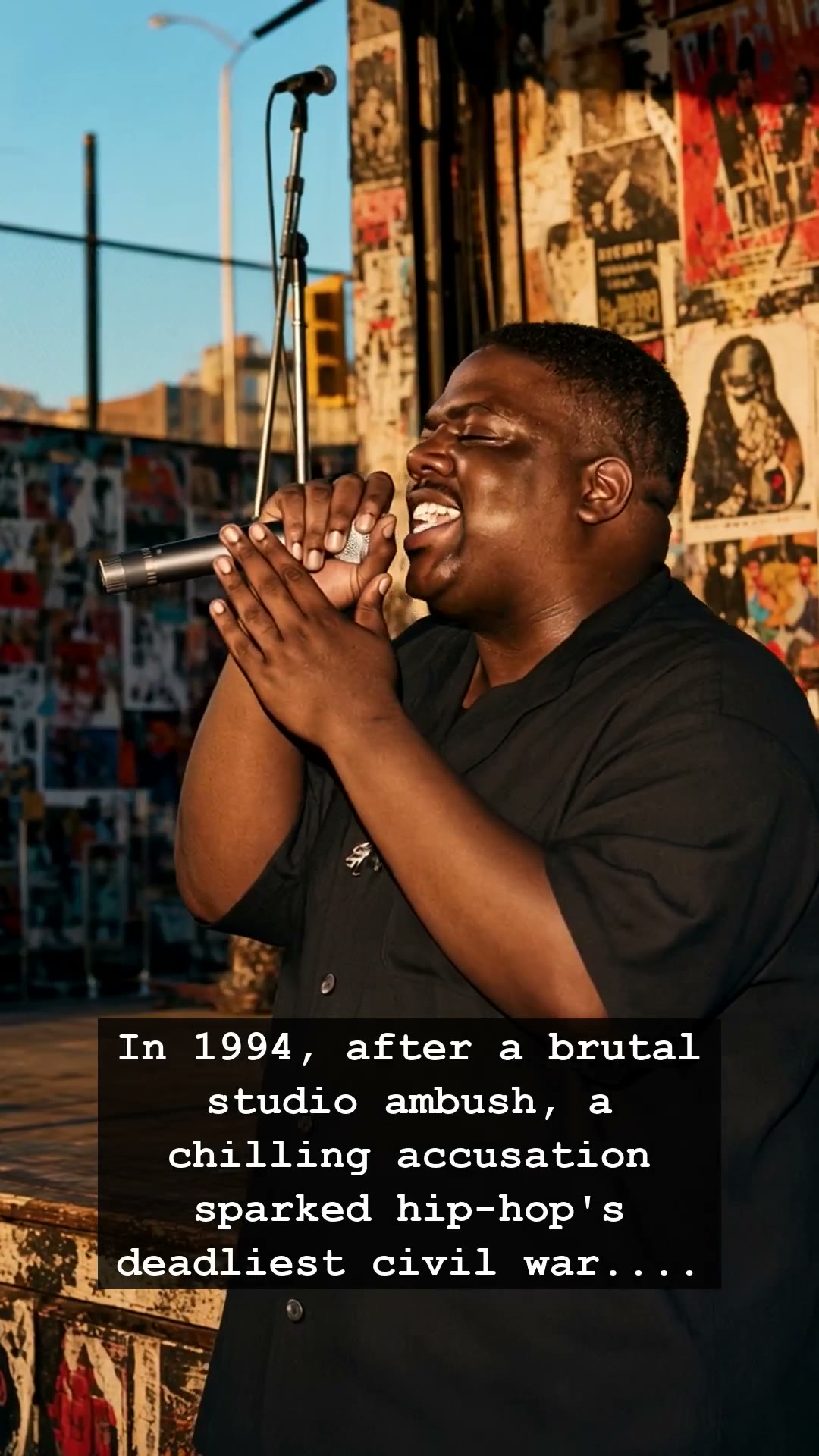
It was November 1994, a time when the rhythmic pulse of the East Coast was defined by the deep, conversational flow of Christopher Wallace, better known as The Notorious B.I.G. The music industry felt like a kingdom of gold chains and oversized jerseys, but beneath the glossy surface of MTV music videos, a dark storm was brewing. The air in New York City was thick with paranoia. When bullets shattered the tranquility of Quad Studios, it was not just a crime scene; it was the starting gun for the most harrowing chapter in musical history. The Notorious B.I.G. found himself at the epicenter of a chilling accusation that would irrevocably tear the hip-hop community apart.
The industry was built on the foundation of the jukebox and the grit of the streets, but suddenly, the narrative shifted from artistic rivalry to a life-or-death struggle. The Notorious B.I.G. was publicly accused of being involved in the ambush of Tupac Shakur at that very studio. This singular allegation acted as a match dropped into a pool of gasoline. For those who lived through the nineties, the tension was palpable. You could feel it every time a track from Ready to Die played on your Walkman; the music was no longer just about the swagger of Brooklyn, but about the fragile line between survival and stardom. The brotherhood of hip-hop had fractured into a polarized divide between the East and West Coasts.
As the media machine stoked the flames, the lives of these legends became intertwined in a tragic, high-stakes drama. The Notorious B.I.G. was a man caught between his astronomical rise to fame and a rapidly deteriorating reality. Behind the scenes, the pressure was suffocating. Studio sessions became fortresses, and the camaraderie that once defined the early nineties golden era vanished. It was a time when the myth of the superstar felt heavy with the weight of consequence, and every public appearance was shrouded in a shadow of uncertainty that even the brightest stage lights of an arena tour could not pierce.
Looking back, the conflict feels like a tragic Greek play set against the backdrop of an urban landscape. The legacy of The Notorious B.I.G. remains complex, marked by his unparalleled lyrical genius that forever altered the architecture of rap music. Yet, we cannot speak of his genius without acknowledging the volatile climate that ultimately defined his final years. The industry learned a hard lesson about the cost of unchecked ego and the dangerous intersection of fame and rumor. It serves as a stark reminder of how quickly the music we love can become entangled in the darker currents of human history.
Today, when we spin his records, the crackle of the vinyl brings us back to a time of immense cultural transition. We remember The Notorious B.I.G. not just as a king of New York, but as a man whose life became a cautionary tale of a fractured era. As the echoes of that civil war continue to resonate in contemporary culture, one has to wonder how much more music we might have been gifted had the industry nurtured peace rather than fueling the fires of rivalry. Turn up the volume tonight, listen to the brilliance of his storytelling, and remember the man behind the myth who stood at the center of the world.