
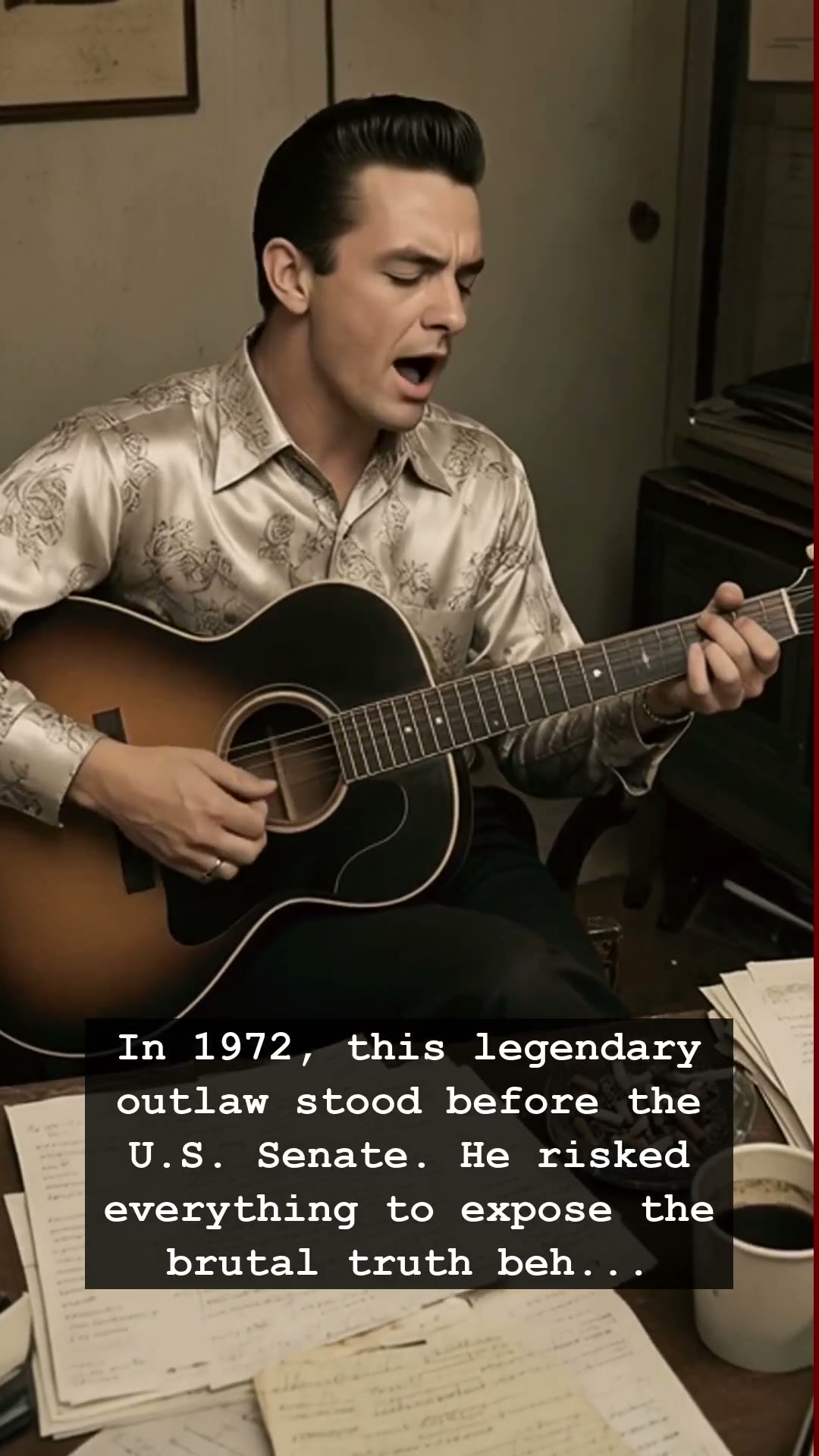
The year was 1972, and the air in Washington D.C. was thick with the sterile tension of bureaucratic coldness. While the rest of America was tuning into the latest hit on their radios or dusting off their vinyl records to listen to the crackle of a warm soul track, one man walked into the United States Senate with a burden far heavier than his guitar case. This was not a performance under the bright, artificial lights of a stadium or the smoke-filled haze of a roadside bar. This was Johnny Cash, the Man in Black, a man who had stared into the abyss of his own demons and returned to tell the tale. He wasn’t there to promote a record or court the spotlight; he was there to pull back the iron curtain on the American penal system, a place he knew all too well from his own brushes with the law.
Johnny Cash carried the scars of his life like badges of honor. He had been a guest of the state in Folsom and San Quentin, and he understood the brutal, crushing reality that existed behind those cold stone walls. When he stood before the Senate Subcommittee on National Penitentiaries, he didn’t offer polite platitudes or rehearsed political rhetoric. With the gravelly, resonant voice that had captured the hearts of millions, he spoke of human degradation, systemic cruelty, and the desperate need for reform. He risked his burgeoning career and his carefully cultivated outlaw image to demand that the world look at the prisoners not as numbers, but as discarded human souls.
It was a moment of sheer audacity that defined the spirit of the era. The 1970s was a decade marked by disillusionment, but Johnny Cash remained a towering, authentic figure in an increasingly manufactured music industry. While the flashy neon lights of Studio 54 were beginning to draw the restless youth and the radio waves were becoming saturated with polished, corporate-produced disco tracks, Cash stood as a reminder of the raw, unfiltered truth of the human experience. His appearance before the Senate was more than a testimony; it was a protest song without a melody, a visceral plea for empathy in a nation that had learned to look away from the darkness.
The echoes of that day still ripple through our culture today. Many remember him for the boom-chicka-boom rhythm of his greatest hits, but his legacy is cemented by this singular act of bravery. He proved that an artist could be more than an entertainer; they could be a mirror held up to society, forcing us to confront the uncomfortable corners of our own existence. That voice, deep and unwavering, served as a beacon for those lost in the system, turning the Man in Black into a symbol of justice for the forgotten.
Even now, when we listen to his timeless recordings, we aren’t just hearing a song; we are hearing the heartbeat of a man who fought for the broken. As the world moves faster and history blurs into the background, the memory of Johnny Cash remains sharp and necessary. He taught us that courage is not the absence of darkness, but the will to walk through it and shine a light for others. Take a moment today to listen to his voice once more, and remember the man who spoke truth to power when silence was the safer choice.