
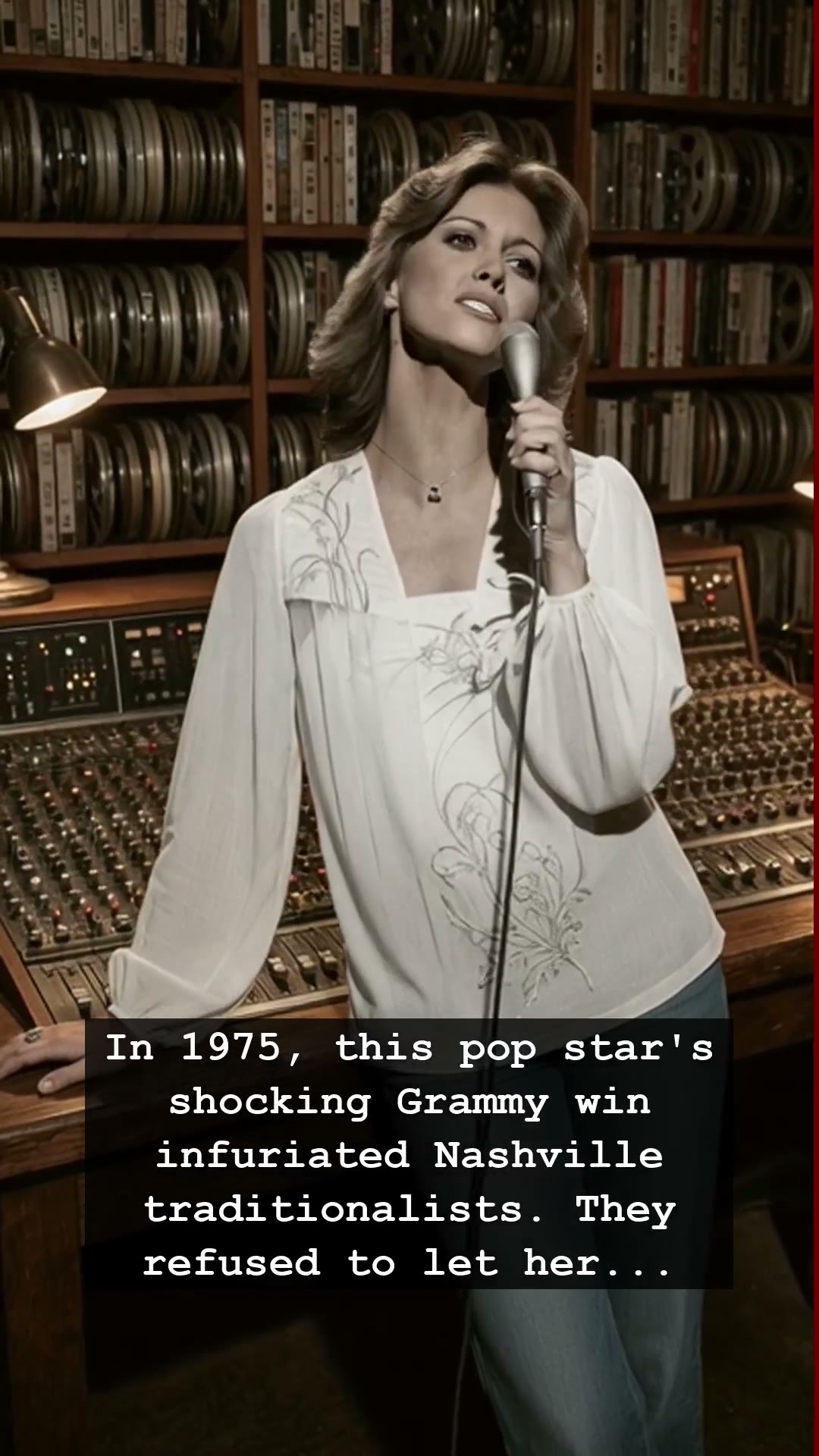
It was the golden era of the Jukebox, a time when the needle dropping on a vinyl record felt like a sacred ritual. Yet, in 1975, the polished, pristine air of Nashville was suddenly thick with smoke and resentment. The catalyst for this underground explosion was not a weathered outlaw or a honky-tonk veteran, but the angelic, Australian-born pop sensation Olivia Newton-John. When her name was announced as the winner of the Country Music Association’s Female Vocalist of the Year award, the industry didn’t just gasp; it went to war. To the hardened traditionalists who lived and breathed the dusty spirit of the Grand Ole Opry, the victory felt like an invasion of pop sensibilities into a hallowed cultural space.
At the time, the lines between genres were supposed to be iron-clad. Olivia Newton-John, with her breezy melodies and clean-cut image, represented a modern, softer sound that clashed with the grit and raw storytelling of traditional country music. The backlash was immediate and vicious. Stalwarts of the genre felt that the authenticity of the Nashville sound was being eroded by radio-friendly crossover hits. They viewed her success as a Trojan horse, fearing that the corporate machinery of pop would wash away the rugged, unvarnished history that defined country music. It was a clash of eras, a defensive stance by those who felt that the culture they had built was being stolen by someone who didn’t understand the struggle of the highway and the heartbreak of the trailer park.
This wasn’t just about one Grammy or one trophy; it was a desperate battle for the soul of an American art form. The drama escalated into an organized rebellion, leading to the formation of the Association of Country Entertainers. Led by industry legends, this group sought to preserve the purity of country music, effectively drawing a line in the sand that forced every artist to choose a side. For Olivia Newton-John, caught in the eye of this hurricane, it was a baptism by fire that highlighted the darker side of fame. She was a woman in a male-dominated industry, criticized not just for her sound, but for her very identity, which didn’t fit the rigid mold Nashville had carved out over decades.
Looking back from the distance of years, the incident remains a fascinating study in cultural gatekeeping. Olivia Newton-John, unfazed and ever-graceful, eventually moved beyond the confines of the genre, proving that true artistry cannot be contained by labels or exclusionary boards. Her resilience amidst the noise of the mid-seventies serves as a powerful reminder of how music, while intended to unite, can often become a flashpoint for our deepest anxieties about change. Today, the lines between country and pop have blurred into obscurity, leaving the 1975 incident as a poignant footnote in the evolution of American sound.
While the anger of those Nashville traditionalists has long since faded into the history books, the music remains. Whether you find yourself spinning her records on an old turntable or hearing her voice on a digital stream, Olivia Newton-John occupies a unique place in our shared nostalgic journey. She reminds us that even when the world tries to box you into a category, your voice is yours alone. Perhaps it is time we pull those records from the shelf, listen past the old controversies, and simply enjoy the melodies that defined a generation.