
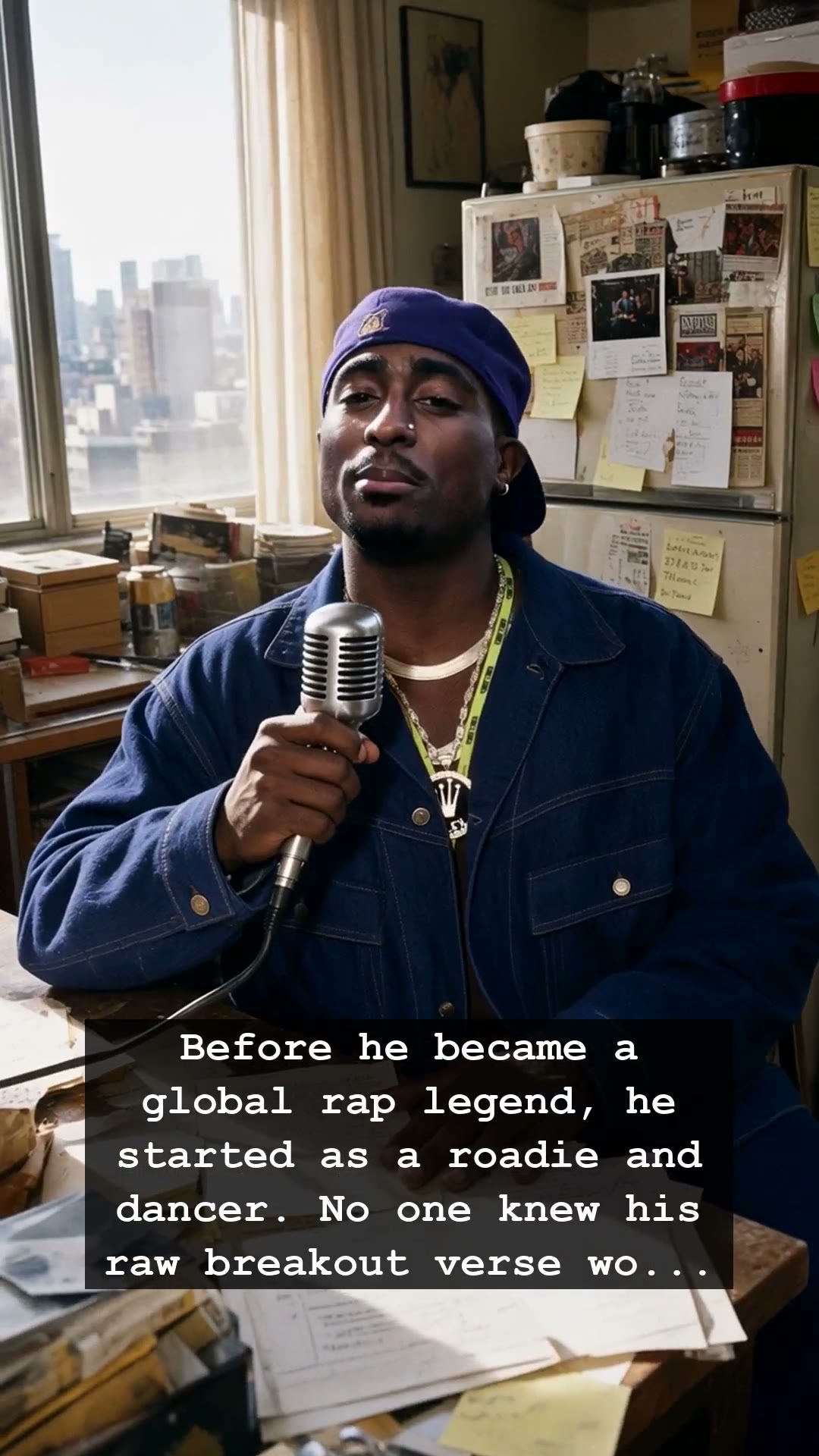
Before the world knew the face of the man who would redefine a generation, Tupac Shakur was merely a ghost in the background. In the early nineties, while the neon lights of the club scene pulsed with the rhythmic heartbeat of New Jack Swing, a young Tupac was far from the spotlight. He was not a king, nor a martyr; he was a roadie and a backup dancer, moving in the periphery of stars who would soon pale in his shadow. There is something profoundly haunting about imagining a future icon wrapping cables or rehearsing choreography in a cramped studio, oblivious to the fact that he was destined to ignite a cultural wildfire that would consume the entire industry.
His transformation began in 1991, a year that felt like the closing of a chapter for traditional hip-hop and the dawn of a more visceral, unfiltered era. While the radio played the infectious, polished beats of the late eighties, Tupac Shakur was sharpening his pen, transforming his internal angst into lyrical gunpowder. When his breakout verse finally hit the airwaves, it did not just capture an audience; it shattered the facade of what a rapper was supposed to be. This was not the glitz of Studio 54 or the manufactured optimism of early MTV; this was raw, bleeding truth delivered with the intensity of a preacher and the grit of the street.
History often highlights the tragedy of his final years, yet the magic lies in his humble beginning. Watching the archival footage of a youthful Tupac Shakur on stage as a dancer offers a jarring, nostalgic perspective. He was hungry, talented, and profoundly overlooked. This duality—the dancer who studied the rhythm of the crowd and the poet who weaponized that rhythm—is exactly why his legacy remains immovable. He knew how to move the people because he had spent years standing exactly where they were, watching the icons from the wings.
As the golden age of hip-hop began to shift toward the dramatic, high-stakes rivalry that would eventually define the East Coast and West Coast divide, Tupac Shakur stood at the epicenter of the storm. His journey serves as a reminder that legends are not born in the comfort of luxury, but forged in the silence of the background. Every roadie, every struggling artist, and every dreamer can see a piece of themselves in his early struggle. He carried the weight of the nineties on his shoulders, an era defined by the crackle of a Walkman and the sudden, sharp transition into a digital, globalized culture.
Today, we look back at Tupac Shakur not just as a musician, but as a bridge between the soul of the eighties and the raw reality of the late twentieth century. His music resonates because it is etched in the struggle of the human condition. While the world may have changed, the stories he told—born from that humble roadie who dared to pick up the microphone—continue to echo through the halls of history. Next time you hear those iconic tracks, listen closely; you are not just hearing a rapper, you are hearing the echo of a legend who started with nothing and changed absolutely everything.