
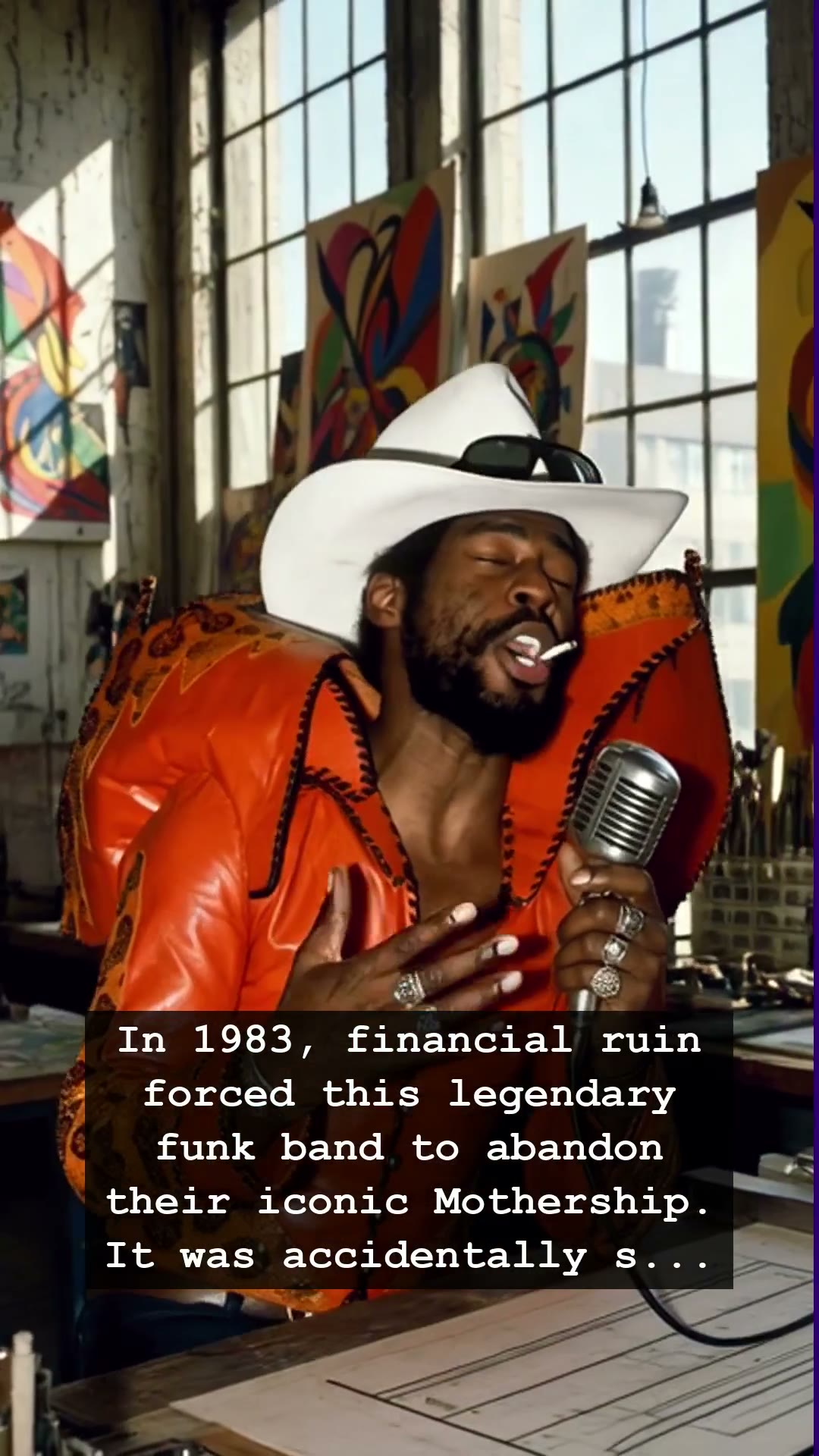
It remains one of the most heartbreaking footnotes in the history of American music. Imagine a gleaming, chrome-plated spacecraft descending from the heavens amidst a haze of dry ice, neon lights, and the infectious, bass-heavy grooves of George Clinton and his collective. For thousands of fans throughout the 1970s, the Mothership was not just a stage prop; it was the ultimate vessel of liberation, the definitive symbol of the P-Funk empire that reigned supreme during the golden era of funk and soul. Yet, by 1983, the glitter of the disco and funk epoch had begun to fade into the synth-pop dawn, and the reality of financial ruin descended upon the legendary Funkadelic.
Following years of touring excess and complex legal disputes, the band found themselves unable to maintain their elaborate stage production. The massive, iconic Mothership, which had ferried George Clinton onto stages from Detroit to Los Angeles, was relegated to a cold, lonely storage yard in Oakland. It sat there, gathering dust, a ghost of the psychedelic funk revolution that had defined a generation. Without the capital to secure its future, the band was forced to abandon their crown jewel. In a twist of fate that reads like a dark rock-and-roll tragedy, the facility owners, unaware of the cultural significance of the vessel, ordered it to be dismantled. The Mothership, once the centerpiece of the most electrifying live show in America, was unceremoniously sent to a scrap yard and shredded into nothingness.
The destruction of the Funkadelic Mothership serves as a brutal reminder of the dark side of fame. While audiences saw the high-voltage energy of the P-Funk experience, the machinery behind the curtain was often fragile, prone to the same economic pressures as any other business. During the early 80s, as the music industry shifted toward the synthesized sounds that would soon dominate the MTV era, the physical remnants of the soul and funk movement were often left to decay. The loss of the ship was not merely the loss of a stage prop; it was the symbolic death of an era where funk was a grand, theatrical statement of cosmic proportions.
Today, we look back at the legacy of Funkadelic with a bittersweet nostalgia. The group pioneered a sound that blurred the lines between hard rock, soul, and rhythm and blues, influencing everything from the birth of hip-hop to modern neo-soul. The absence of the original Mothership makes the surviving concert footage feel even more sacred. It reminds us that even the most legendary icons of the 1970s were susceptible to the harsh winds of change and economic instability.
Though the metal has long been recycled and the neon lights extinguished, the vibrations of Funkadelic remain immortal. Every time the heavy, distorted basslines of their records hit our speakers, the ship rises once again in our collective imagination. It is a testament to the fact that while symbols can be scrapped, the soul of the music will always find a way to fly.