
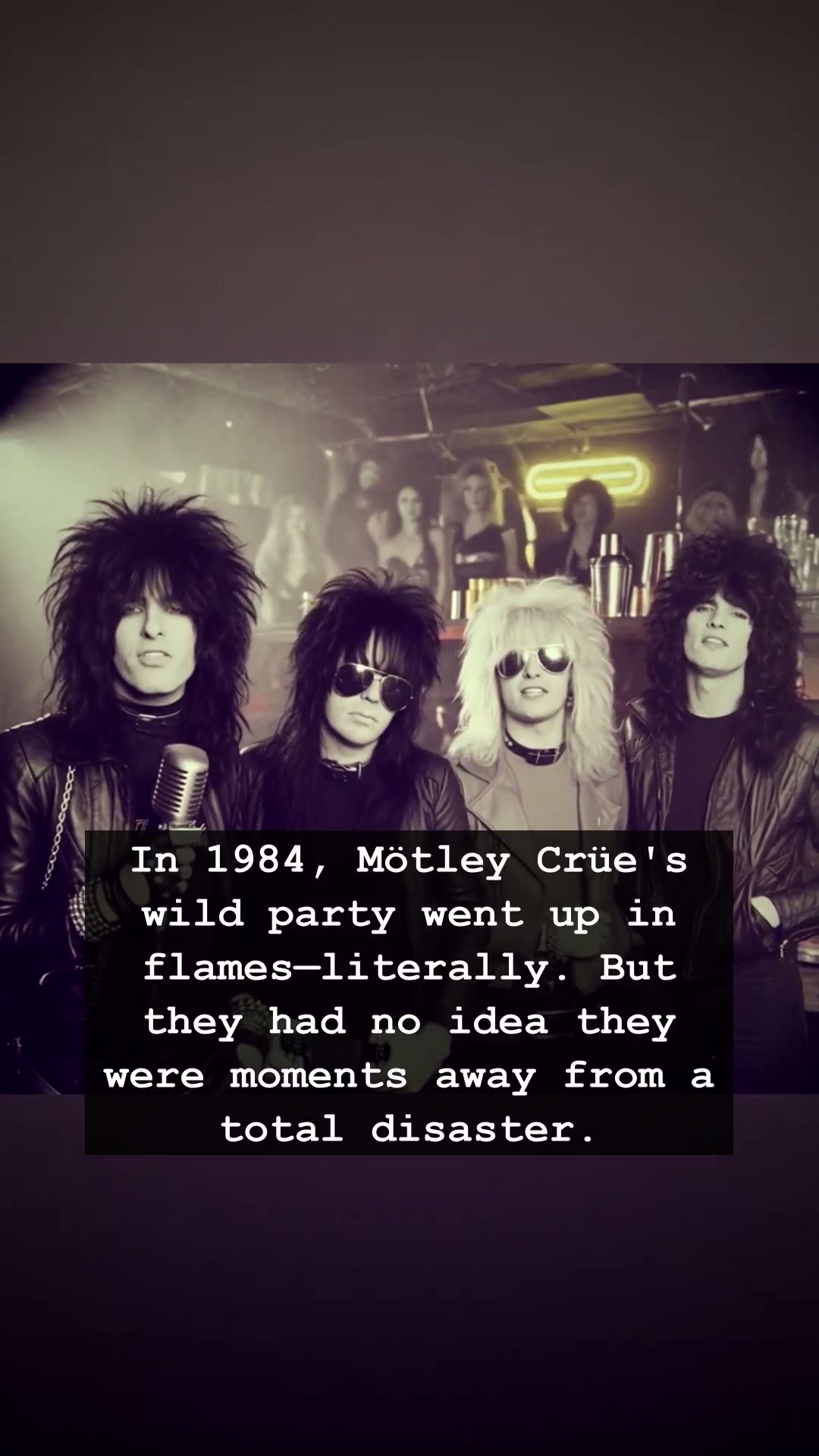
The year was 1984, a time when hair was teased to the heavens, leather pants were practically a second skin, and the Sunset Strip in Los Angeles was the pulsing heart of the musical universe. For Mötley Crüe, life was not just about the chart-topping riffs or the glitz of MTV; it was a relentless, high-octane blur of excess. They were the undisputed kings of the Sunset Strip, living with an audacity that made the rest of the world seem dull. But one humid L.A. night, the party moved from the clubs to the hotel suites, and the line between legendary rock status and total catastrophe vanished in a cloud of smoke and fire.
It started like any other wild gathering for Mötley Crüe, fueled by the era’s signature decadence. The members were at the peak of their notoriety, thriving in an environment where rules were merely suggestions. As the night spiraled into the early hours, a careless spark ignited a massive fire in their hotel suite. Within moments, the room was engulfed in flames, and the hallway turned into a terrifying corridor of heat and thick, choking smoke. While the band members were known for their indestructible personas, they were suddenly faced with the raw, unforgiving reality of a structure failing around them. The luxury of the hotel was momentarily forgotten as they scrambled to escape a disaster that nearly claimed their lives.
Looking back at that night, it serves as a vivid time capsule of the 1980s. Mötley Crüe represented the untamed id of the decade, a group that pushed every boundary until those boundaries physically fought back. It was a time when musicians lived as if they were immortal, shielded by the roar of stadium crowds and the constant validation of their massive, devoted fanbase. That fire was not just a close call; it was a dark turning point that illustrated the dangerous intersection of fame, substance, and pure, reckless youth. The story remains a staple of rock and roll lore, whispered in backstage alleys and etched into the history of American music.
What makes the Mötley Crüe story so enduring is the raw, unapologetic honesty about their own self-destruction. Unlike the polished acts of today, they lived their drama in the public eye, often embracing the chaos rather than hiding it. The fire of 1984 acts as a metaphor for their entire trajectory: brilliant, volatile, and perpetually on the edge of implosion. Decades later, when we revisit their discography, we are not just listening to songs; we are hearing the echoes of a period where rock icons felt like gods, even as they danced on the edge of the abyss.
Today, we look back at Mötley Crüe with a mix of awe and disbelief. The leather, the hairspray, and the sheer audacity of the eighties created a vacuum that no modern band has managed to replicate. As you turn up the volume on your favorite track tonight, take a moment to imagine the smoke and the chaos of that hotel floor in 1984. It is a reminder that rock and roll was never meant to be safe—it was meant to be dangerous, unforgettable, and burning with a fire that refuses to go out.