
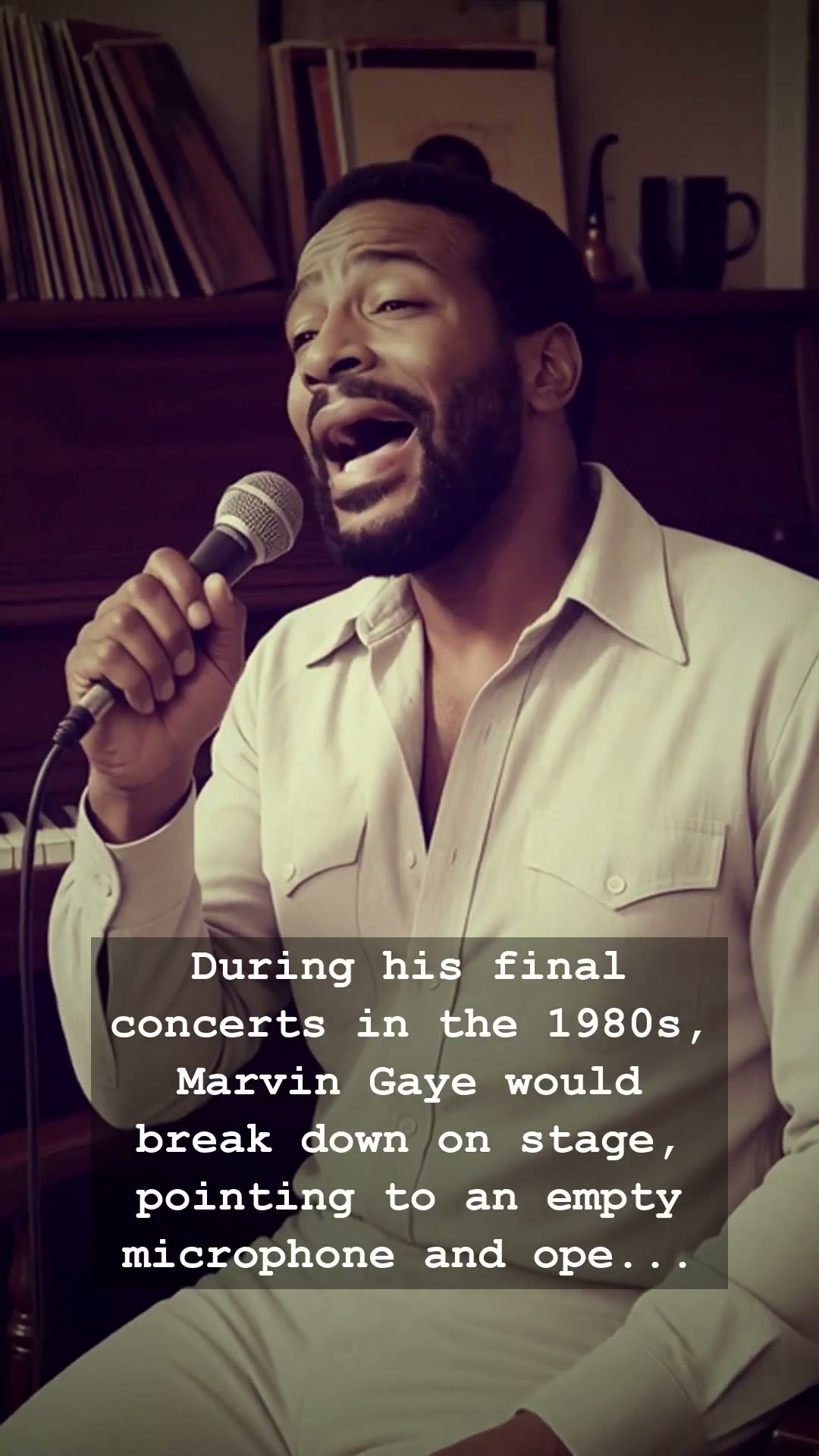
The stage lights were never enough to illuminate the darkness growing inside Marvin Gaye during his final tours in the early 1980s. While the world saw a Motown icon, those who stood in the front rows of his concerts witnessed something far more raw and unsettling. There were moments when the smooth, velvety prince of soul would simply stop. He would gesture toward an empty microphone stand, his eyes glassy and vacant, and begin to weep openly before his audience. He was not performing; he was grieving, haunted by a ghost that had never truly left his side: his legendary singing partner, Tammi Terrell.
To understand the gravity of these breakdowns, one must travel back to the golden era of Detroit’s Hitsville U.S.A. When Marvin Gaye and Tammi Terrell stepped into the recording booth together, they created a sonic alchemy that defined an entire generation. Hits like Ain’t No Mountain High Enough were more than just radio staples; they were anthems of pure, unadulterated joy. But behind the polished Motown exterior, the reality was stark. Tammi Terrell’s tragic collapse into Marvin Gaye’s arms during a 1967 performance in Virginia was the beginning of a nightmare that would eventually claim her life at the age of twenty-four, leaving Marvin Gaye in a spiral of survivor’s guilt that would plague him for the rest of his existence.
The 1980s were a turbulent time for Marvin Gaye, a man struggling with the fading allure of the disco era and the encroaching shadow of his own personal demons. He was a man out of time, often hiding away in the solitude of his home or the smoke-filled corners of recording studios, trying to reconcile the man he was with the myth the public demanded. During those final, haunting concerts, the barrier between the performer and the man vanished. When he reached for that empty microphone, he was reaching across the veil, trying to find the harmony that had been stolen from him years prior. It was a visceral, heartbreaking reminder that even the greatest voices can be silenced by the weight of memory.
Critics and fans alike were often stunned by the unpredictability of these late-career shows. One moment he was the masterful showman, and the next, he was a broken soul lost in the echo of the past. These moments of vulnerability were not publicity stunts or calculated drama; they were the authentic cries of a man who felt he had lost his musical soulmate. The pressure of fame, combined with the heavy toll of his substance struggles, created an environment where Marvin Gaye felt increasingly isolated, even while standing under the glare of the spotlight.
Decades later, the legend of Marvin Gaye remains etched into the history of American music, not just for his chart-topping hits, but for the profound humanity he brought to every note. His story is a somber reminder that the greatest artists often carry the heaviest burdens. When we listen to his voice today, we aren’t just hearing a masterpiece; we are hearing a man who spent his final days reaching for a ghost, trying to find one last melody in the silence. Perhaps the next time you hear their duets, you will hear more than just the music—you will hear the echoes of a love and a loss that time could never quite heal.