
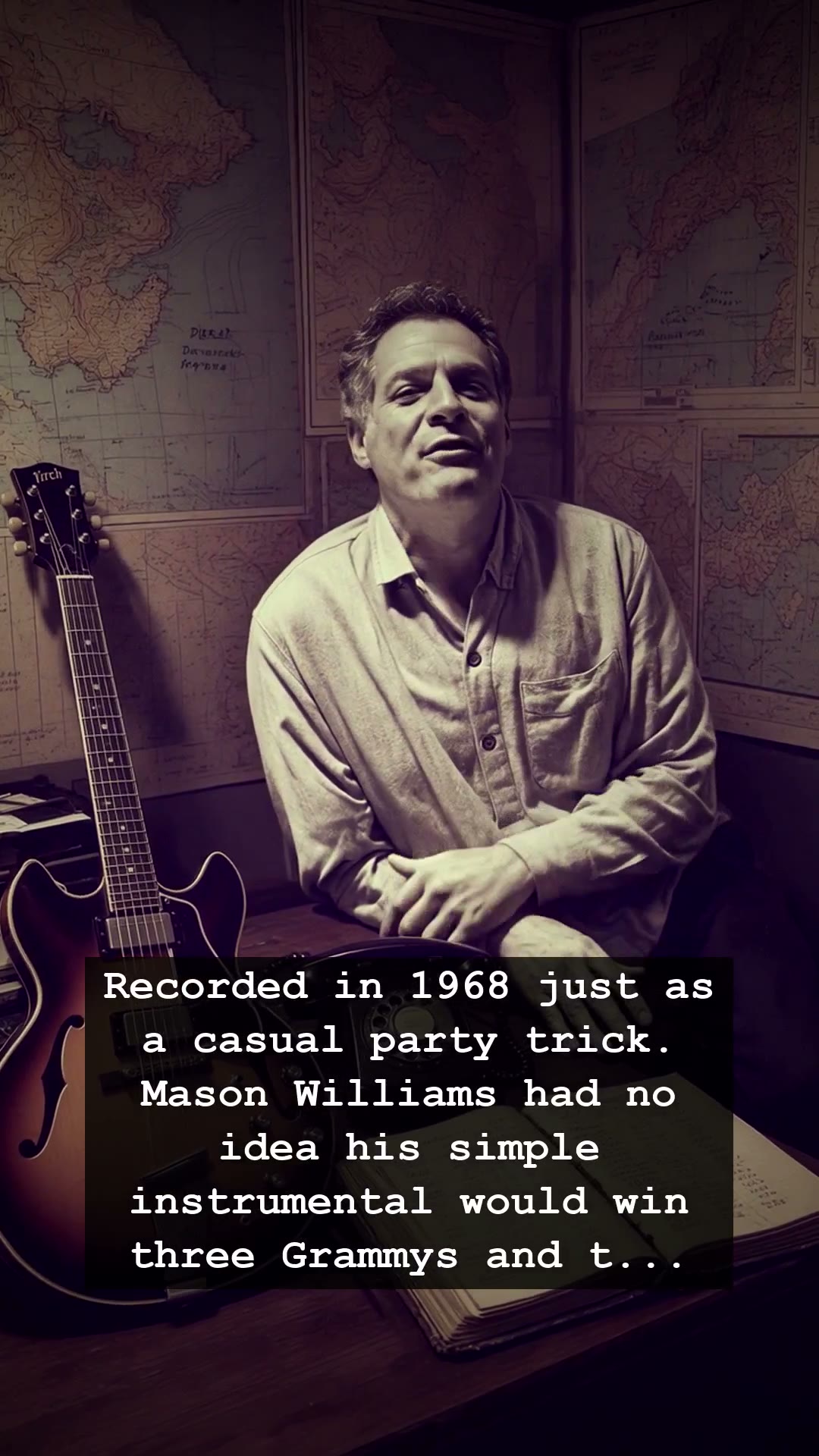
The year was 1968, a time when the world felt like it was shifting on its axis. Across the airwaves, the sounds of the psychedelic era were dominated by distorted guitars and heavy, rebellious lyrics. Yet, amidst the chaos of the late sixties, a single, jaunty instrumental tune began to climb the charts, defying all logic. It was Classical Gas, the brainchild of Mason Williams. Most listeners assumed it was the work of a seasoned classical composer or a refined studio veteran, but the truth was far more humble. Mason Williams was, at the time, a desperate comedy writer working for the Smothers Brothers, juggling the high-pressure world of television while harboring a secret, burning passion for guitar composition.
For Mason Williams, this track was never intended to be an anthem for a generation. It began life as little more than a party trick—a melody he would pluck on his guitar to amuse friends during late-night gatherings. He recorded it almost as an afterthought, never anticipating that his casual experiment would shatter the status quo of the music industry. In an era defined by the rise of the Walkman and the cultural dominance of television variety shows, Classical Gas emerged as a strange, uplifting anomaly. It became a bridge between the stiff formality of traditional orchestral arrangements and the freewheeling, creative energy of the psychedelic rock movement.
When the track finally hit the airwaves, it caught fire with a speed that startled even Mason Williams himself. It was a lightning strike of success that culminated in three Grammy Awards, a feat that felt surreal for a man who primarily spent his days crafting punchlines. The song became a fixture of the late sixties, a sound that lived in the background of jukeboxes across America, providing a crisp, sophisticated contrast to the heavier sounds of the time. It is a classic example of the accidental brilliance that occasionally defines music history; while others were chasing trends, Mason Williams had stumbled into a timeless sound by simply following his own curiosity.
Looking back, the story of Mason Williams serves as a poignant reminder of the fragility of fame and the unpredictability of art. The era was not just about the loud rebellions or the dark corners of the rock scene; it was also about these moments of pure, melodic clarity. The success of Classical Gas remains a testament to how a single, well-crafted melody can cut through the noise of any decade. It remains a staple of nostalgia, evoking the specific texture of 1968—a world of black-and-white television screens and the rapid heartbeat of a shifting cultural landscape.
Decades later, the legacy of Mason Williams is firmly cemented in the pantheon of instrumental guitar masters. Whether you were hearing it for the first time on a crackling transistor radio or rediscovering it in a modern playlist, the tune retains its infectious, driving spirit. It reminds us that sometimes, the most profound artistic statements are not the ones we agonize over for years, but the ones we create when we are simply being ourselves. Next time you hear those iconic opening notes, take a moment to remember the comedy writer who didn’t just write a song, but captured the unpredictable lightning of his time.