
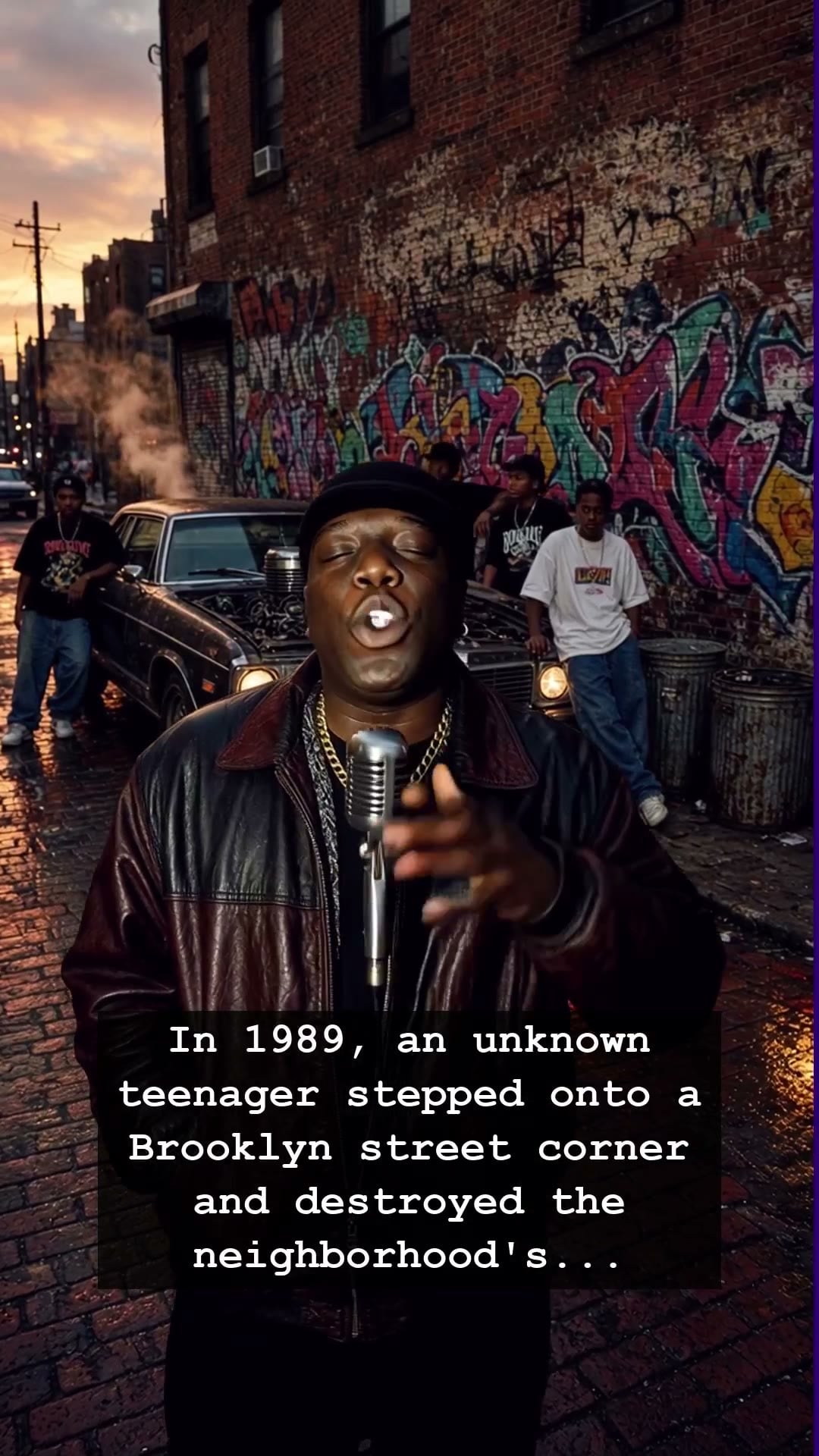
The year was 1989. The air in Brooklyn was thick with the humid weight of a city in transition, buzzing with the sound of boomboxes echoing off brick facades. On a nondescript street corner, the status quo of local hip-hop was about to be dismantled by a seventeen-year-old kid named Christopher Wallace. He was just a teenager with a heavy frame and an even heavier flow, a name unknown to the industry but feared by the neighborhood veterans. When he stepped into the circle to face the reigning freestyle champion, the crowd expected a quick disposal. Instead, they witnessed a moment of cultural tectonic shifting that would eventually define the landscape of East Coast hip-hop.
As Wallace opened his mouth, the chatter of the crowd faded into a stunned silence. His words were not just rhymes; they were snapshots of a gritty reality, delivered with a rhythmic precision that felt ancient and futuristic all at once. The reigning champion, once considered untouchable, was suddenly a footnote in his own neighborhood. This was the moment The Notorious B.I.G. was truly born, long before the tailored suits, the Versace shades, and the chart-topping records that would dominate the mid-nineties. It was raw, unpolished, and dangerously talented.
Looking back at that era, it is easy to forget how much of hip-hop’s soul was forged in the heat of these public battles. Before the polish of high-budget music videos and the ubiquity of MTV, the music lived on street corners and in the grooves of dusty vinyl. This was a time when your reputation was built entirely on your ability to hold a crowd in the palm of your hand. For The Notorious B.I.G., that Brooklyn corner was his proving ground, a crucible where his larger-than-life persona began to take shape amidst the concrete and chaos of New York City.
The tragedy of his meteoric rise is forever tied to the intensity of the world he emerged from. The Notorious B.I.G. carried the weight of Brooklyn’s streets into every studio he entered, blending vivid, cinematic storytelling with a rhythmic genius that few have ever matched. He was the voice of a generation that felt ignored, turning his experiences with struggle and ambition into a poetic anthem for the East Coast. Every verse he laid down felt like a transmission from the heart of the city, a voice that was both deeply personal and universally resonant.
Decades later, the legacy of The Notorious B.I.G. continues to reverberate through every corner of the music industry. We look back at that 1989 encounter not just as a piece of trivia, but as the origin story of an American icon. It reminds us that legends are not born in boardrooms, but in the spontaneous, electric moments of truth found on the streets. If you close your eyes and listen to his early tapes, you can still hear the hunger of that teenager from Brooklyn, reminding us that no matter how far he climbed, he never truly left that street corner behind.