
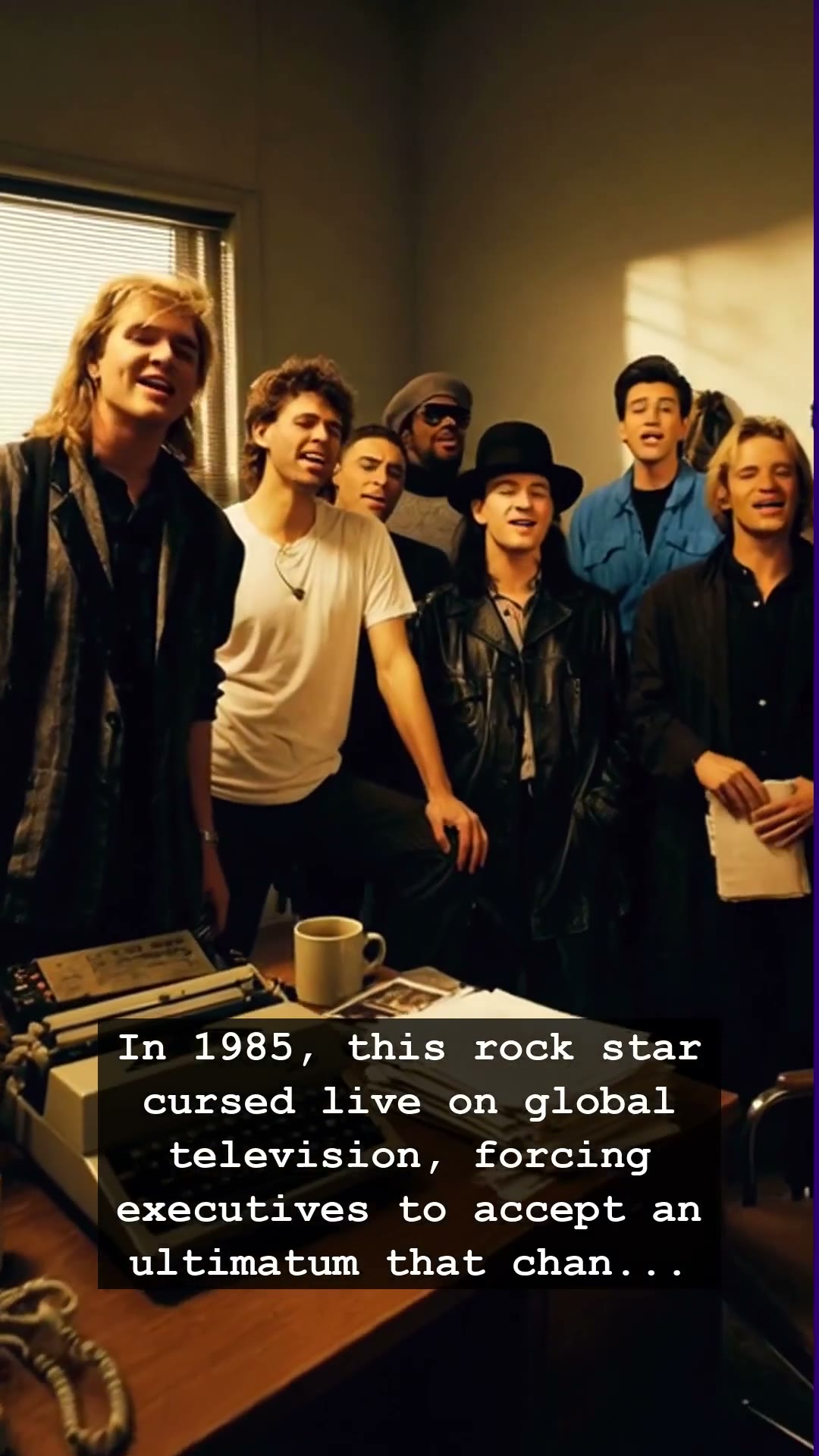
The year was 1985, and the world was watching a spectacle unlike any other. As the Live Aid broadcast crackled through television sets across the globe, the air was thick with the polished artifice of the MTV era. Everyone was looking for a performance, but they got a reckoning instead. Standing before millions, Bob Geldof—the brash, sharp-tongued frontman of the Boomtown Rats—decided that polite requests were no longer enough to save lives. In a moment of raw, unvarnished humanity that terrified the network executives huddled in the control room, Bob Geldof leaned into the microphone and cursed live on global television, demanding the audience dig deep into their pockets for the starving in Ethiopia. It was an unfiltered ultimatum that shamed a generation into action and redefined the power of a rock star.
To understand the gravity of that afternoon at Wembley Stadium, one must remember the landscape of the mid-eighties. We were living in a world of high-gloss music videos, neon synth-pop, and the burgeoning dominance of the Walkman. Charity was often a distant, corporate affair, but Bob Geldof changed the trajectory of the decade by injecting a sense of desperate, urgent urgency into the stadium rock arena. He didn’t just want to perform; he wanted to mobilize. Behind the scenes, the pressure was immense. The logistics were a nightmare, and the political indifference was suffocating. Bob Geldof knew that the only way to break through the apathy of the era was to hold the television audience hostage with the sheer force of his own righteous anger.
The shock was palpable. Network executives, terrified of FCC fines and public backlash, scrambled as the expletive echoed through the airwaves. Yet, in that single act of rebellion, Bob Geldof captured the zeitgeist. He moved beyond the persona of a mere musician and became a cultural provocateur. The broadcast that day was more than just a concert; it was a pivotal moment in history where rock and roll abandoned its hedonistic roots to confront the reality of human suffering. It stripped away the vanity of celebrity and forced the viewers to confront their own place in a global tragedy.
Looking back at that grainy footage today, it is easy to feel a profound sense of nostalgia. We are transported back to a time before the digital age, where live events felt like communal, shared experiences that could genuinely shift the needle of public consciousness. Bob Geldof remains a polarizing, complex figure, but his contribution that July afternoon remains one of the most significant flashes of morality in the history of music. He proved that even in an age of calculated image-making, one man’s voice, raw and unfiltered, could move the world.
Decades later, the legacy of that moment persists. While the glitter of the eighties has faded, the image of Bob Geldof, frantic and uncompromising, remains burned into our collective memory. It serves as a reminder that behind every legendary performance, there lies a human story driven by chaos, ego, and eventually, a desperate need for change. Do you remember where you were when the world decided to listen?