
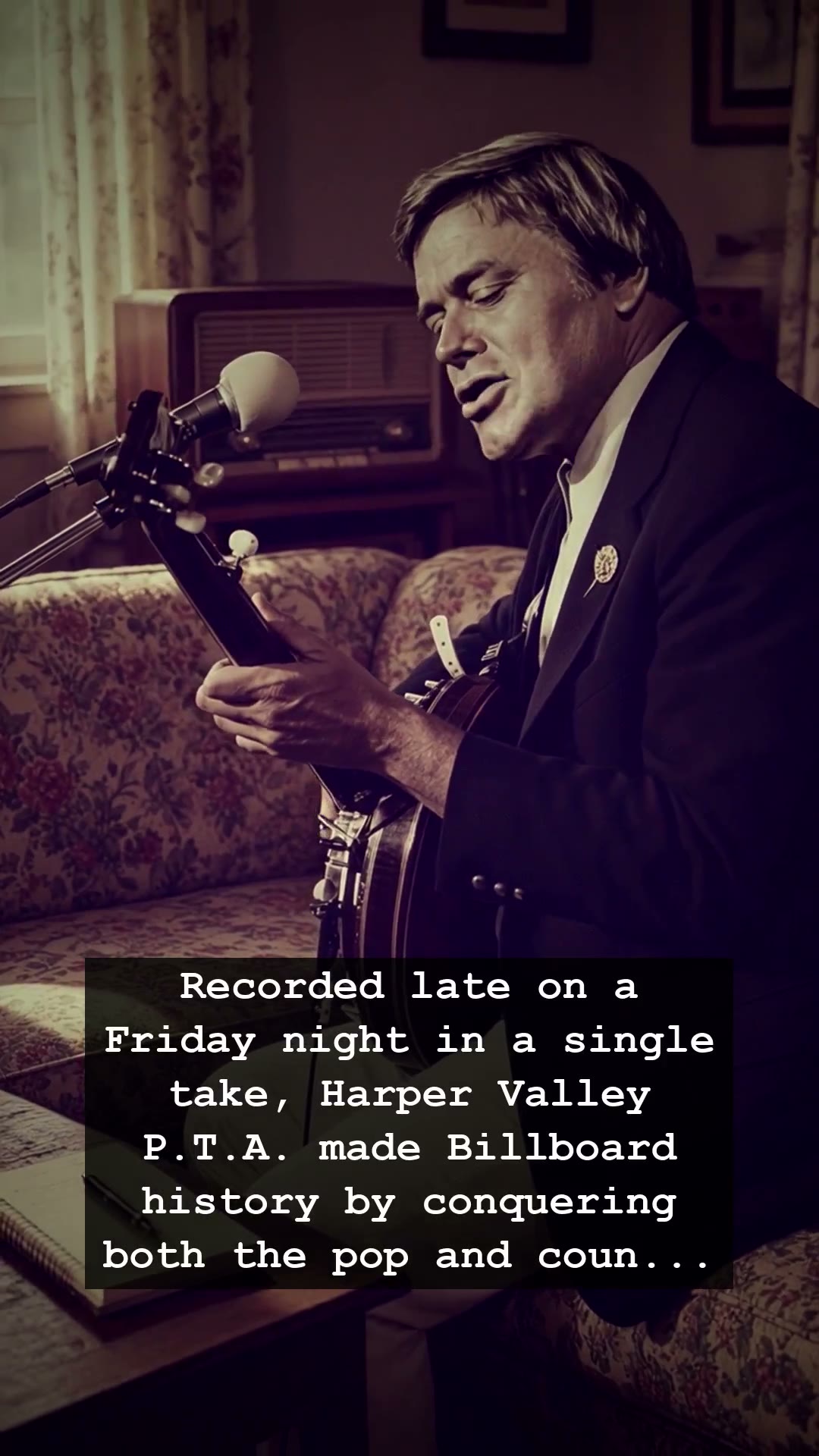
It was a late Friday night in 1968, the kind of quiet, humid evening where the air feels heavy with unspoken secrets. Inside a cramped Nashville studio, a young singer named Jeannie C. Riley stepped up to the microphone. With the ink barely dry on the lyrics penned by the legendary songwriter Tom T. Hall, she took a deep breath and delivered a performance that would change music history forever. In a single, gritty take, she captured the simmering resentment of small-town hypocrisy, unknowingly birthing a cultural phenomenon that would soon blast out of every jukebox from rural Tennessee to the bustling heart of New York City.
That song was Harper Valley P.T.A., a razor-sharp critique of moral judgment that struck a nerve deep within the American psyche. Tom T. Hall, a master storyteller known for his ability to distill complex human emotions into three-minute vignettes, had crafted a narrative that felt dangerously real. It was a time when the world was shifting; the post-war innocence of the fifties was dissolving into the complex, rebellious spirit of the late sixties. When the song hit the airwaves, it didn’t just climb the charts; it ignited a firestorm. It became the first track by a female soloist to simultaneously conquer both the pop and country Billboard charts, a feat that felt nothing short of miraculous in an era dominated by rigid genre boundaries.
The genius of the track lay in its raw, unfiltered defiance. Jeannie C. Riley shed the polished veneer expected of country stars at the time, opting instead for a vocal performance that dripped with righteous indignation. To listeners of the era, the song felt like a cinematic revelation. It turned the P.T.A. meetings that once defined small-town respectability into a courtroom of scandals, exposing the double standards of the local elite. As the catchy, driving rhythm poured out of transistor radios and Walkmans, it gave a voice to the voiceless, resonating with anyone who had ever felt judged by those standing on a higher moral pedestal.
Looking back, the success of Harper Valley P.T.A. is a testament to the songwriting brilliance of Tom T. Hall. He possessed an uncanny ability to find the dark, dramatic corners of the American experience and shine a light on them. He didn’t just write songs; he built worlds. Behind the scenes, the music industry was struggling to bridge the gap between traditional Nashville roots and the evolving pop sensibilities of the youth movement. This song served as a bridge, proving that a story well-told has no borders. It was a moment of perfect synchronicity where talent, timing, and a touch of late-night studio magic collided to create an enduring classic.
Today, listening to those opening chords still transports us back to a time of diners, diners, and unfiltered expression. It remains a poignant reminder of how music can dismantle social constructs and challenge the status quo. The legacy of Jeannie C. Riley and the narrative crafted by Tom T. Hall continues to echo through generations, reminding us that even the quietest voices can cause a revolution when they finally decide to speak the truth. Let this classic track serve as your soundtrack to a night of quiet reflection on the stories that still demand to be told.