
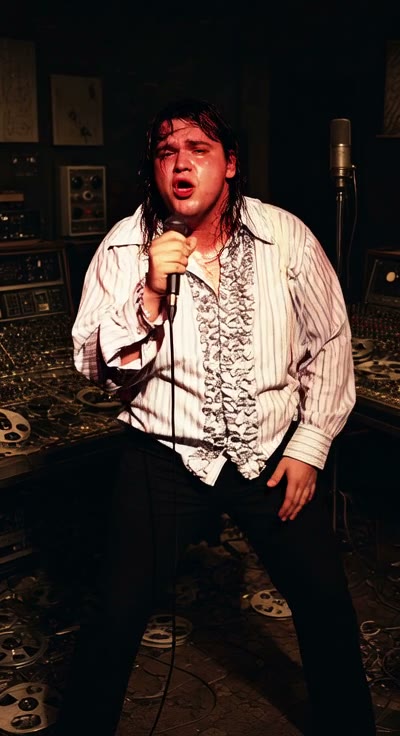
The year was 1987, an era defined by the neon glow of MTV, the rise of the Walkman, and the glitz of royal charity events that brought the music industry’s biggest icons face-to-face with the British monarchy. It was supposed to be a dignified affair, a televised moment of prestige and philanthropy. But for Meat Loaf, the larger-than-life powerhouse behind Bat Out of Hell, the competitive spirit was never just for show. In a turn of events that would leave television producers scrambling and the royal security detail breathless, the legendary rocker found himself in a heated confrontation that culminated in him chasing a prince across the manicured grounds of the estate. It was a raw, chaotic, and utterly unforgettable glimpse into the volatile personality of one of rock’s most enigmatic figures.
To understand this bizarre explosion, one must look at the man himself. Meat Loaf was not just a singer; he was a theatrical hurricane, a performer who poured every ounce of his tortured, operatic soul into his craft. During the eighties, his persona was often caught between the fading glam of his seventies success and the pressures of a changing musical landscape. The charity event, meant to foster a sense of unity, inadvertently became the stage for a dramatic collision of egos. For Meat Loaf, whose entire career was built on high-stakes drama and emotional intensity, the boundary between performance and reality often blurred. The physical pursuit of royalty wasn’t just a lapse in judgment; it was an authentic, if extreme, manifestation of the intensity that fans adored him for.
The incident sent shockwaves through the press, quickly cementing itself as one of the most absurd scandals of the decade. While the public watched with wide-eyed disbelief, those close to the music industry knew this was merely a symptom of the era’s unchecked rock star ego. The late eighties were a time when celebrities were treated as untouchable deities, and the clash between a blue-blooded royal and a rough-edged rock icon felt like a seismic shift in the cultural zeitgeist. It was a moment where the grandeur of the monarchy met the unpredictable, often dangerous energy of pure, unadulterated rock ‘n’ roll.
Looking back, this chaotic memory serves as a bridge to a time when fame felt more visceral and less curated. Meat Loaf represented a generation of artists who lived their lives in the spotlight without a filter. Whether he was belting out power ballads in a dimly lit studio or sprinting across a royal garden, he was always undeniably himself. This story remains a testament to his uncompromising character, reminding us that behind every platinum record were human beings prone to fire, fury, and moments of absolute madness that define the legends we still celebrate today.
Even decades later, as we rediscover the magic of the 1980s through the crackle of vinyl and the nostalgia of classic radio, the image of a breathless Meat Loaf remains etched in history. It is a reminder that rock icons were never meant to be perfectly polished statues; they were flawed, explosive, and infinitely human. So, the next time you spin one of his epic tracks, remember the man who didn’t just sing about fire and brimstone—he lived it, one frantic, royal chase at a time.