
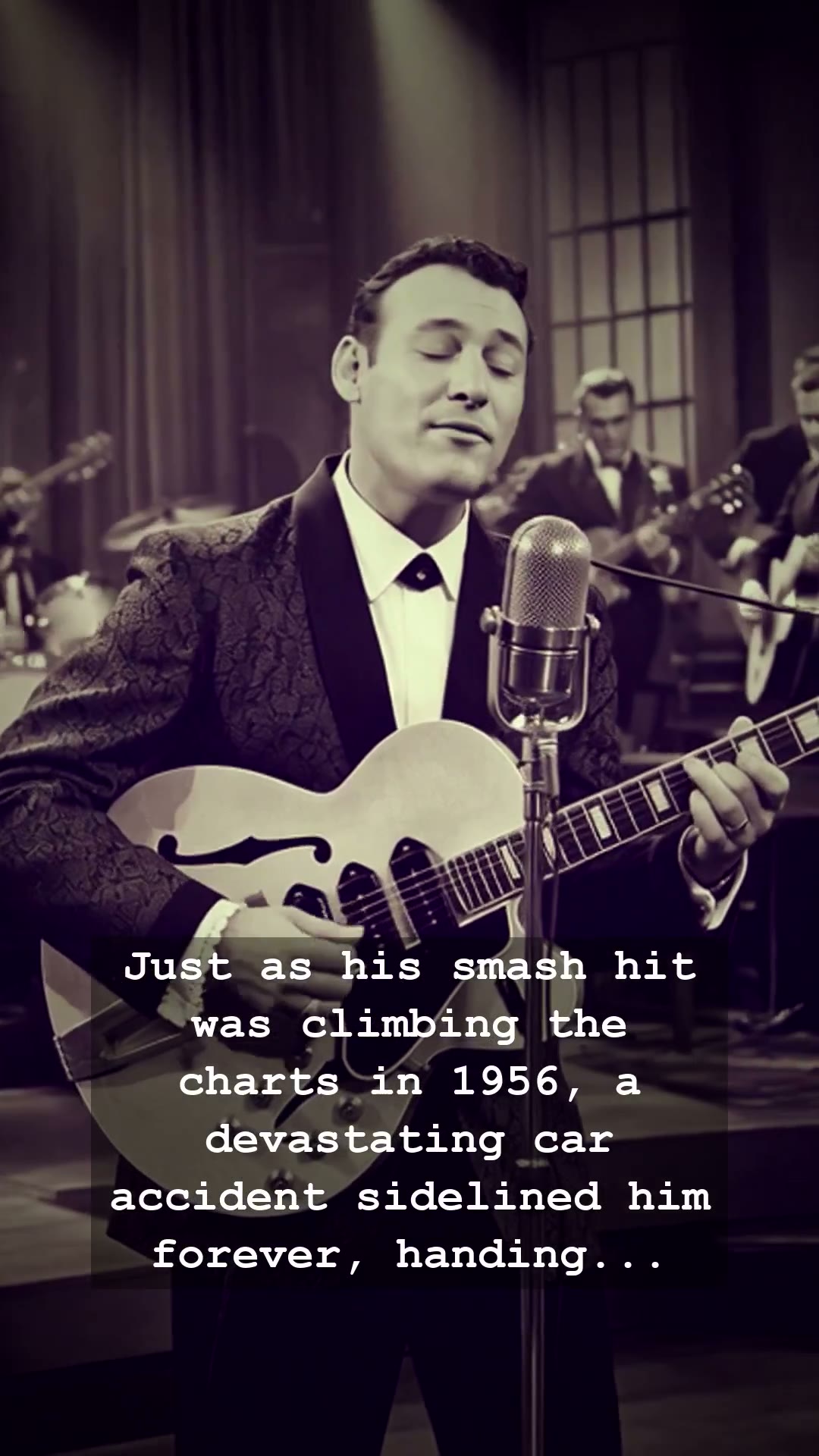
It was March 1956, and the airwaves across America were crackling with a new, dangerous energy. Teenagers were huddling around their living room radios and dropping nickels into the local diner jukeboxes, hungry for the raw, thumping pulse of Rock ‘n’ Roll. Carl Perkins, a humble man with a guitar he played like a machine gun, had just birthed Blue Suede Shoes. It was a cultural earthquake, a song that defined the era as much as the iconic leather jackets and greased hair of the time. Carl Perkins was on the fast track to becoming the undisputed king of this new frontier. But in the fickle world of fame, the highway of dreams can turn into a graveyard in a split second.
While heading to New York for a national television appearance that would have cemented his place in the pantheon of legends, fate took a gruesome turn. Near Dover, Delaware, the car carrying Carl Perkins and his band slammed into a pickup truck. The aftermath was catastrophic. His driver was killed, and Carl Perkins suffered a fractured skull and broken bones that left him fighting for his life in a hospital bed. As he lay trapped in a darkened room, tethered to machines rather than the spotlight, the world outside kept turning. He could hear the faint echoes of the charts shifting. His momentum, that golden window of opportunity, was bleeding out on the asphalt.
While Carl Perkins struggled to breathe and eventually to walk, another man was waiting in the wings, ready to capture the magic. Elvis Presley, with his magnetic charisma and undeniable sway, took the song to the masses. The public, fickle and quick to move on, saw Elvis take Blue Suede Shoes to the stratosphere. While Carl Perkins had the soul and the grit that birthed the sound, Elvis had the media machine and, most importantly, the ability to show up to the cameras. It is one of the most haunting “what if” scenarios in the history of music. How different would the golden age of Rock ‘n’ Roll have looked if the man who wrote the anthem hadn’t been sidelined by a pile of twisted metal?
Returning to the music scene after his recovery, Carl Perkins found that the landscape had irrevocably shifted. The industry had moved on to the next sensation, and while he remained a respected craftsman among his peers, the crown of commercial dominance had slipped through his fingers. He became the architect of a sound he watched others build skyscrapers upon. He toured, he played, and he continued to influence the legends who came after him, from The Beatles to Johnny Cash, but the pure, unadulterated superstardom he was poised to claim had evaporated.
Today, we look back at the career of Carl Perkins with a sense of profound melancholy and deep respect. He remains the unsung hero of the 1950s, a man whose talent was matched only by his bad luck. When we spin those old records, hearing the sharp, percussive bite of his guitar, we aren’t just listening to a hit song; we are listening to a ghost of what might have been. The next time you hear those opening chords, remember the man who paid the price for the birth of a genre, a titan whose legacy is etched not just in wax, but in the tragic, beautiful history of American music.