
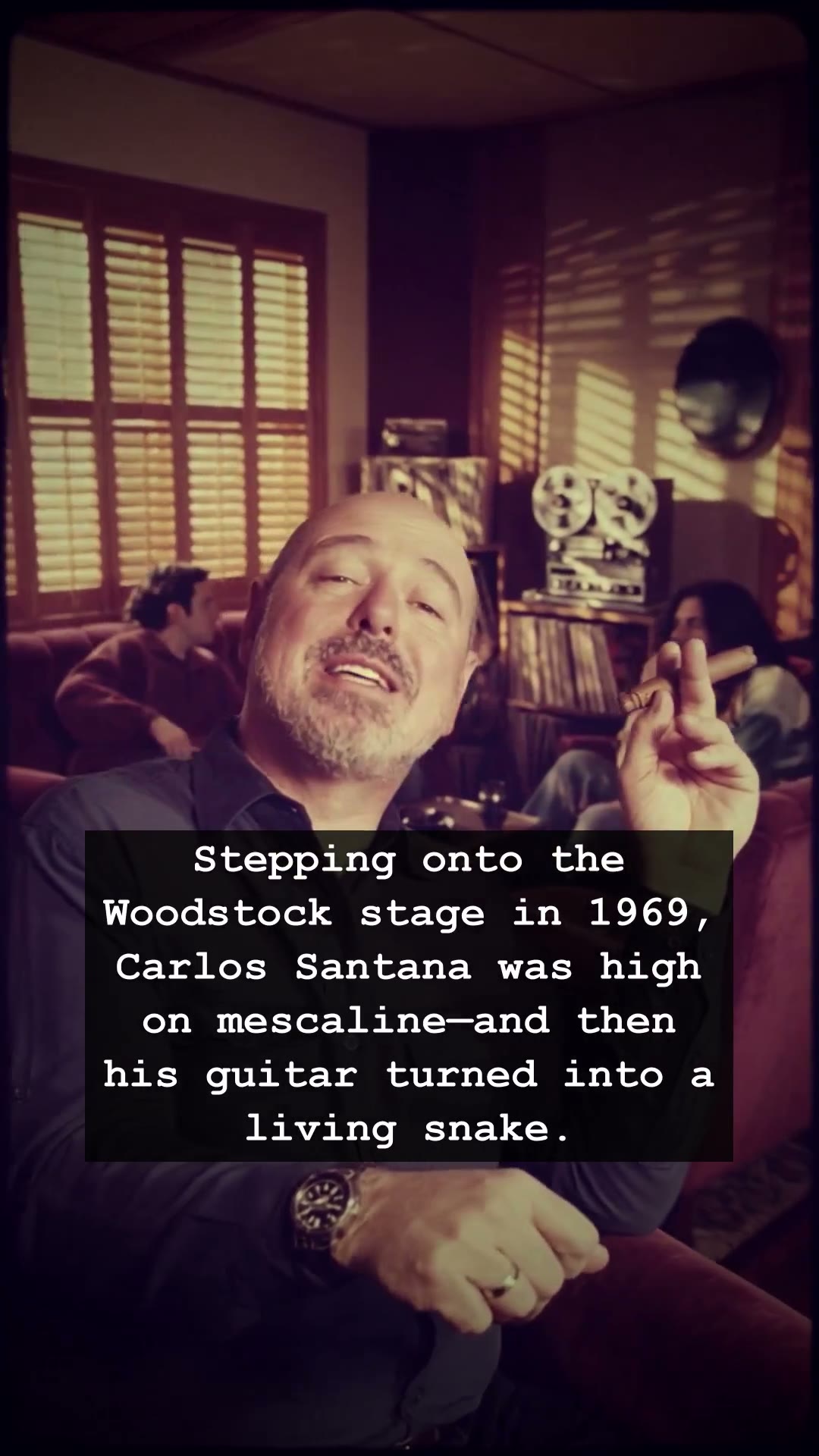
The year was 1969. The air at Woodstock was thick with the scent of wet grass, rebellion, and a collective dream that defied the gravity of the mundane world. As the afternoon sun began to dip, a young, relatively unknown guitarist named Carlos Santana stepped onto the legendary stage. He wasn’t just nervous; he was chemically altered. Before his set, someone had offered him mescaline, and in the spirit of the psychedelic era, he indulged. He expected a spiritual awakening, but as he strapped on his Gibson SG, reality began to warp into something far more sinister.
As the band dove into their set, the hallucinogens took a dark, primal turn. Carlos Santana later recounted a moment that would have sent any other musician sprinting for the shadows: his guitar neck began to twist and contort, morphing into a literal, writhing snake in his hands. The fretboard felt like scales, and the vibrating strings felt like the hissing of a predator. Panic surged through him, a cold, suffocating terror that threatened to silence his music entirely. He wasn’t just performing; he was fighting for his sanity amidst a sea of half a million mesmerized spectators.
Instead of collapsing, Carlos Santana did the only thing a true virtuoso could do: he poured that absolute, raw fear into his instrument. He focused on the only thing that felt real—the rhythm. He gripped the neck of that ‘living snake’ and channeled his terror into the Latin-infused, hypnotic wails that would eventually become the hallmark of his sound. That performance of Soul Sacrifice is now etched in history as one of the most blistering displays of guitar mastery ever captured on film. It was the birth of a legend forged in the crucible of a psychedelic nightmare.
Looking back from our modern era of polished digital production, it is easy to forget the grit of the late sixties. Woodstock wasn’t just a festival; it was a cultural pressure cooker. Artists like Carlos Santana existed on the edge, walking a tightrope between creative genius and the absolute madness of the era. The music that poured out of him that day wasn’t just notes on a page; it was a visceral reaction to the unknown, a frantic dialogue between a man and his shifting reality. It remains a testament to the idea that some of our greatest art is born when we are backed into a corner by our own fears.
Today, Carlos Santana stands as an icon of rock history, his melodic phrasing still capable of evoking that same electric tension he felt in the summer of 1969. Every time we hear those familiar opening bars of his work, we aren’t just listening to a track; we are hearing a survivor’s song. It reminds us that behind the myth of the guitar god lies a human soul, one who once stared down a hallucination and emerged with a sound that would change the world forever. Next time you drop the needle on a record, remember that sometimes, the music is the only thing keeping the snakes at bay.